What material should a drying box for cannabis be made of?
When drying and fermenting cannabis, the material determines the flavour, shelf life and quality. But which material is really ideal? Plastic, metal, cardboard or wood?
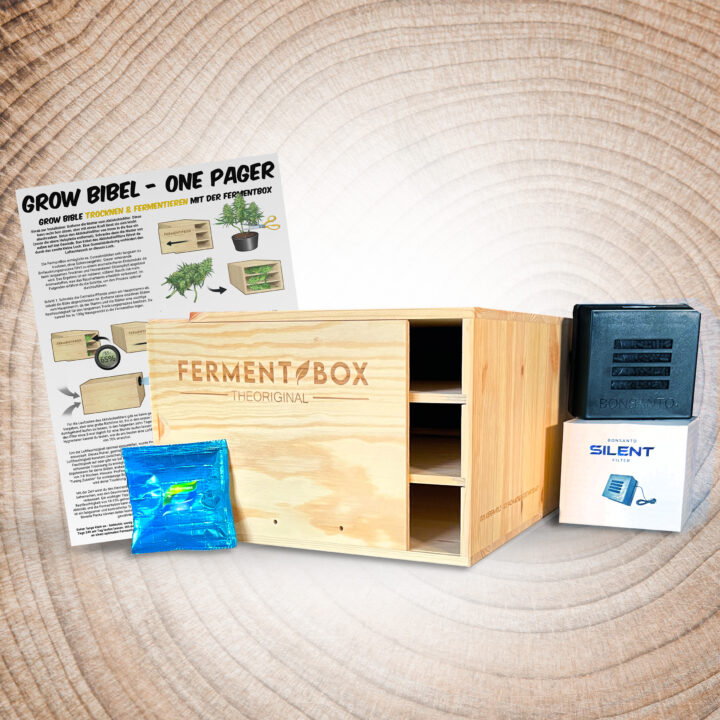
Wooden cannabis drying box with accessories
Why the material is crucial for quality and flavour
Choosing the right material is one of the most important factors in post-harvesting. A good drying box must not only be stable, but also breathable, odour-proof and temperature-resistant. The material influences the Air circulation, moisture and the preservation of terpenes - and thus the flavour and effect of the end product.
Many growers underestimate this point: even at the optimum temperature, the wrong material can lead to Mould formation, hay odour or loss of aroma lead.
Video: How material and moisture affect the result
Video: The role of material & moisture in cannabis drying - explained using the FermentBox® as an example.
Material comparison: wood, plastic, metal or cardboard?
| Material | Advantages | Disadvantages |
|---|---|---|
| Wood | Breathable, natural moisture regulation, odourless, durable | Somewhat more expensive, requires good workmanship to prevent warping |
| Plastic | Lightweight, affordable, easy to clean | No moisture regulation, risk of mould, often odour development when warm |
| Metal | Very robust, durable | No insulation, climate too dry, condensation possible |
| Cardboard / cardboard | Inexpensive, readily available | High risk of mould, no odour control, hardly any moisture stability |
Why wood is the ideal material for drying boxes
Wood is a living material that naturally regulates humidity. It absorbs excess moisture and releases it again when the air becomes too dry - without any sensors or electronics. As a result, the relative humidity remains stable, which minimises the Terpene preservation and uniform drying supported.
Solid wood also has an insulating effect and reduces temperature fluctuations, which is particularly important for sensitive flowers. No other material creates such a Balanced microclimate for the drying process.

FermentBox® - the perfect drying box made of wood
The FermentBox® from Bonsanto utilises precisely these properties: It consists of solid, untreated wood, which automatically equalises the climate inside. Supplemented by a quiet Activated carbon filter and the ProFerment system the humidity remains constant between 60-65 %, without any digital control.
The result: uniform, natural drying - without hay odour, without mould and with maximum flavour retention.
Conclusion: Natural material - natural results
A good drying box is more than just a container - it is a controlled microclimate. Plastic and metal cannot regulate the environment, cardboard is too risky. Wood on the other hand, offers the perfect balance of stability, breathability and natural climate control.
This is exactly where the FermentBox® comes in - it combines traditional craftsmanship with modern technology and creates the optimal conditions for perfect curing and fermentation.
How durable are wooden drying boxes compared to other materials?
Drying boxes made of wood are very durable if well made and usually last for many years. In comparison, plastic ages more quickly, metal offers no climate control and cardboard can only be used for a short time.Which material best prevents hay odour when drying cannabis?
Wood is the most reliable way of preventing hay odours, as it naturally regulates moisture and enables even, gentle drying.Which material is best for a cannabis drying box?
Wood is the best material because it creates a stable microclimate, preserves aroma and reduces the risk of mould or drying out.-
Jonny's Drybox - Drying box with activated charcoal filter - DIY kit
59,99 € Add to cart -
 -20%
-20%
FermentBox® - Drying, curing & fermentation box made of wood
Sale! Original price was: 149,00 €.119,00 €Current price is: 119,00 €. Add to cart